
There’s a strange little ritual taking hold in classrooms and offices: someone reads a polished report, raises an eyebrow, and announces, “This was clearly written by AI.”
Case closed. Apparently, proper punctuation has become probable cause.
This isn’t entirely hypothetical. In 2023, a professor at Texas A&M University–Commerce questioned students’ assignments after asking ChatGPT whether it had written them. Several students were subsequently cleared, and the university confirmed nobody failed the class or was barred from graduation over the incident.
A chatbot investigating its own alleged handiwork. What could possibly go wrong?
But consider the more interesting question: What if AI actually did help write it?
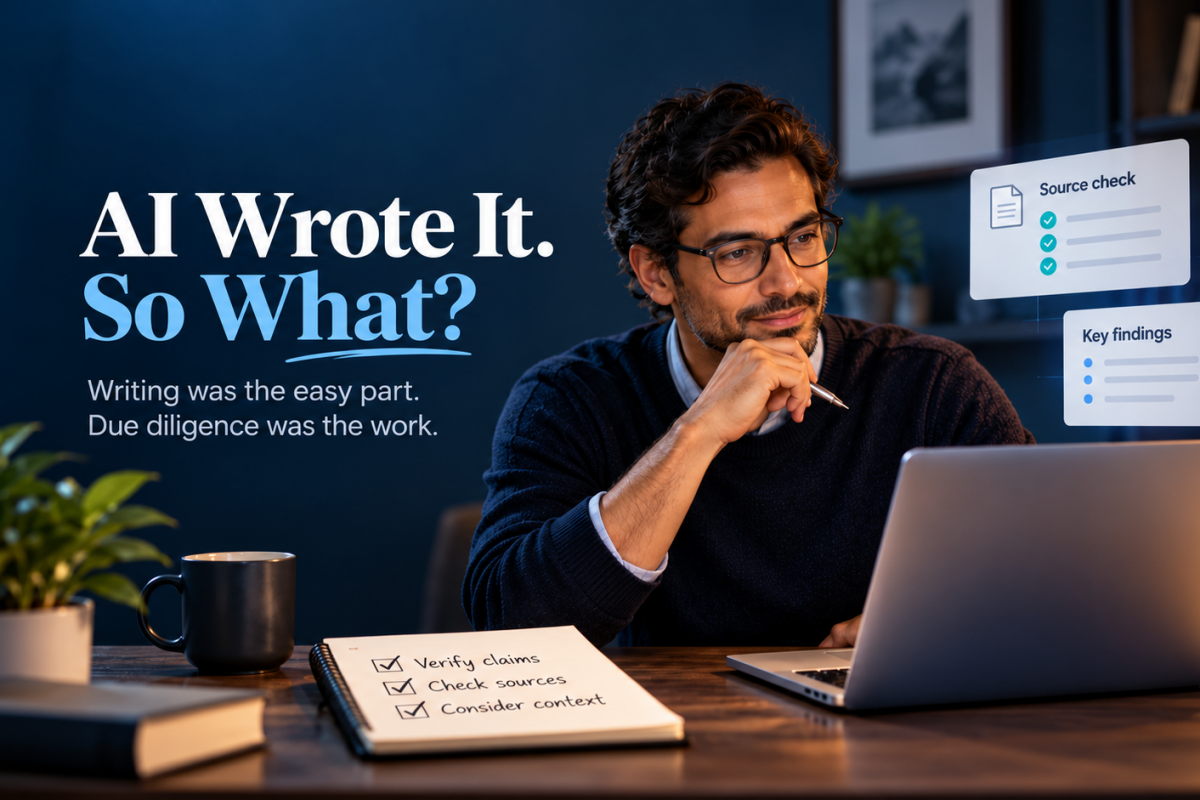
Writing was the easy part.
In a piece worth publishing, someone still needs to decide what’s worth saying, find credible sources, reconcile conflicting claims, check dates and numbers, understand the underlying problem, and reach a defensible conclusion.
That work isn’t glamorous. It doesn’t produce the satisfying little dopamine hit of a finished page. But it’s where the value lives.
AI can help with that process, too. It can surface contradictions, challenge assumptions, organize evidence, and make good analysis easier to communicate. What it cannot do is relieve the person publishing the work of responsibility for its accuracy.
Fluency isn’t proof. Sometimes it’s just a very confident mistake wearing a nice jacket.
The productivity gains are real.
In a 2023 study published in Science, researchers found that professionals using ChatGPT spent 40% less time on writing tasks, with output quality improving by 18%.
A 2025 study in The Quarterly Journal of Economics found a 15% productivity increase among customer-support agents using AI assistance, with particularly strong benefits for less-experienced workers.
Neither study suggests AI magically makes everything better. It shows that people can accomplish more with a capable tool and the right process.
Which, last I checked, is precisely why we invent tools.
We’ve confused effort with merit for too long. Hours spent staring at a blank document don’t make an argument more rigorous. And an elegant paragraph doesn’t automatically make it true.
So when somebody says, “AI wrote that,” I’d rather ask a few different questions.
Are the facts correct? Is the reasoning sound? Does it help someone make a better decision?
If so, perhaps we should stop policing the keyboard and start appreciating the thinking.